
What does my child need in order to feel safe enough to succeed? What the Empowering Principle in TBRI offers to help parents answer this question.
A child who looks defiant may actually be hungry. A child who refuses to transition may be overwhelmed by noise. A child who melts down over a small request may be running on too little sleep, too much stress, or no clear sense of what comes next.
Trust-Based Relational Intervention, often called TBRI, helps adults look beneath behavior and ask a better question: What does this child need in order to feel safe enough to do well?
The Empowering Principle in TBRI begins there. It focuses on meeting physical, sensory, and environmental needs so a child’s nervous system can settle. When the body feels safer, the brain has more room for learning, connection, problem-solving, and cooperation.
Parents put this into daily practice by focusing first on empowering principle. Children learn best when they feel safe, soothed, secure, seen, connected, and calm. When those foundations are missing, negative behavior increases and becomes the communicator.

What the Empowering Principle means in TBRI
The Empowering Principle is about giving children what they need to succeed before asking them to behave differently.
That sounds simple, but it changes the whole posture of parenting. Instead of starting with correction, the adult starts with support. Instead of assuming the child is choosing to make things hard, the adult considers whether the child’s body, senses, or environment are already under stress.
A dysregulated child is not in their best thinking brain. When a child is hungry, tired, dehydrated, overstimulated, rushed, or unsure of what will happen next, the brain can shift toward survival. In that state, even ordinary requests can feel too big.
“Put your shoes on.”
“Stop touching that.”
“Come to the table.”
“Use your words.”
These may seem small to an adult. To a child whose nervous system is already overloaded, they can land like threats or demands they cannot manage.
The Empowering Principle asks adults to lower the stress where they can. That may mean offering water before homework, building in movement before church, giving a five-minute warning before leaving the park, or creating a quiet space after school.
This is not permissive parenting. It is preparation. It says, “Your body matters. Your needs matter. You do not have to fight for survival here.”

Physical needs can drive behavior more than we think
Many challenging moments begin in the body. Adults can forget this because they have learned to push through discomfort. Children often cannot. Their bodies speak loudly, and behavior becomes the language.
A child who is hungry may whine, grab, rage, or refuse to follow directions. A child who is thirsty may seem unfocused. A child who is tired may become impulsive. A child who has been sitting too long may start climbing, poking, crashing, or irritating siblings.
Before assuming a child is being difficult, it helps to check the basics.
Food
Regular snacks can make a major difference, especially during transitions, errands, after school, or before a demanding task. A protein-rich snack can support steadier energy better than a sugary treat alone.
Water
Hydration is easy to overlook. Keeping water nearby, offering it before outings, and building it into routines can prevent some struggles before they start.
Sleep and rest
A tired child may not act sleepy. They may act wild, rigid, tearful, or aggressive. Rest time, quiet time, and predictable bedtime rhythms give the body a chance to recover.
Movement
Some children need movement before they can focus. Jumping, pushing a laundry basket, animal walks, wall push-ups, dancing, or a quick walk outside can help the body organize.
A simple body check can sound like this:
“Before we talk about what happened, let’s get a drink of water and take three big breaths together.”
That small pause can prevent correction from becoming a power struggle.
Sensory needs are real needs
Sensory input shapes how safe a child feels. Some children are easily overwhelmed by sound, light, touch, smells, crowds, or clothing textures. Others seek strong input through movement, pressure, chewing, spinning, or crashing.
Neither pattern means a child is bad. It means the nervous system is asking for help.
TBRI encourages caregivers to notice sensory patterns and offer support before the child reaches a breaking point. The goal is not to remove every discomfort from life. The goal is to help the child build tolerance with support, not shame.
Useful sensory supports may include:
Fidgets during listening times
Weighted blankets or lap pads when appropriate
A quiet corner with soft lighting
Noise-reducing headphones
Chewable jewelry designed for that purpose
Movement breaks before seated work
Heavy work, such as carrying groceries or pushing a wagon
Soft clothing options when tags or seams are distressing
A child who chews pencils may need safe oral input. A child who crashes into furniture may need heavy work. A child who melts down in a grocery store may need fewer errands, a snack before entering, headphones, or a clear job to do.
The key is to observe without blame.
Try asking:
What happened right before the behavior?
Was the setting loud, crowded, bright, or chaotic?
Had the child eaten or had water?
Was there a transition?
Did the child know what to expect?
Did the child have any control or choice?
Patterns often appear when adults slow down enough to look.

Predictability helps the nervous system feel safe
Children feel safer when life has some rhythm. Predictability does not mean every day must be rigid. It means the child has enough structure to understand what is happening now, what is happening next, and what adults expect.
For children who have experienced stress, trauma, loss, or big life changes, unpredictability can feel threatening. Even pleasant surprises may be hard. The nervous system may stay on alert, scanning for danger or disappointment.
Clear routines reduce that load.
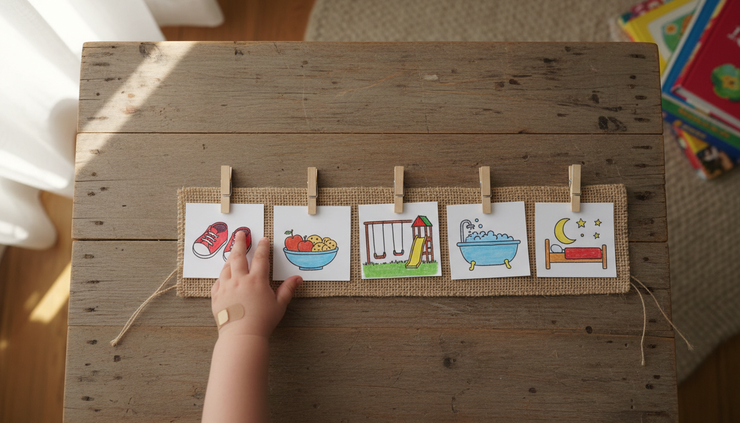
A morning routine might include:
Wake up
Bathroom
Get dressed
Eat breakfast
Brush teeth
Shoes
Backpack
Leave for school
A bedtime routine might include:
Snack
Bath or wash up
Pajamas
Brush teeth
Story
Prayer, song, or quiet connection
Lights out
Visual schedules can help young children and children who struggle with language, memory, or transitions. The schedule does not need to be fancy. Photos, drawings, or simple words on paper can work.
Gentle transitions also matter. Many children struggle when asked to stop one activity and begin another, especially if the shift feels sudden.
Helpful transition supports include:
“Five more minutes, then we clean up.”
“After this puzzle, we will put on shoes.”
“Do you want to hop or tiptoe to the bathroom?”
“When the timer rings, it is time for dinner.”
“You can carry the keys or hold my hand.”
Choices can reduce power struggles because they give the child a sense of agency inside a clear boundary. The adult still sets the limit. The child gets a voice within it.
For example:
“It is time to get dressed. Do you want the green shirt or the striped shirt?”
“We are leaving the park. Do you want to walk to the car or have me carry you?”
“Homework time starts now. Do you want to use pencil or marker?”
“You need a break. Do you want the beanbag or the rocking chair?”
The choice is real, but it is not endless. Too many options can overwhelm a child. Two acceptable choices often work best.
Felt safety is more than being safe
A child may be physically safe and still not feel safe. TBRI often uses the idea of felt safety, which means the child’s body and brain experience safety, not just the adult’s logic.
An adult may think, “There is nothing to be afraid of.” The child’s nervous system may still be saying, “Something is wrong.”
Felt safety grows through repeated experiences of care. The child learns, little by little, that adults respond to needs, repair after conflict, keep their word, and stay connected during hard moments.
This is where Empowering and Connecting work together. Snacks, water, movement, routines, sensory tools, and gentle transitions are not just behavior strategies. They send relational messages.
They say:
“I notice you.”
“I am paying attention.”
“I will help you before things fall apart.”
“Your needs are not too much.”
“You can trust me to lead with care.”
That trust cannot be rushed. Some children test it. Some resist it. Some seem to reject help because help has not always felt safe before. Consistency matters more than perfection.
When adults miss the need, they can repair.
“I got frustrated and raised my voice. I am sorry. Let’s try again.”
That kind of repair teaches more than a perfect response ever could.
What this looks like in everyday parenting
The Empowering Principle becomes most useful in ordinary moments. It is not a script. It is a way of seeing.
Before homework
A child comes home from school irritable and refuses homework.
A connection-first, body-aware response might be:
“School took a lot of energy today. Let’s have a snack and ten minutes outside. Then we will sit together and start with the first problem.”
The adult still expects homework. The child first gets food, movement, and connection.
Before errands
A child often melts down at the store.
Support might include:
A snack before leaving
Water in the car
A short list with pictures
A clear job, such as holding the apples
Noise-reducing headphones
A reminder of what happens after the store
The plan reduces stress before behavior escalates.
During sibling conflict
A child grabs a toy and screams.
A connection-first response might be:
“I will not let you grab. You really wanted a turn. Let’s take a breath, then I will help you ask.”
The adult sets a boundary, names the need, and teaches the skill once the child is calmer.
At bedtime
A child becomes silly, demanding, and resistant every night.
Instead of assuming manipulation, the adult might look for patterns. Is bedtime too late? Is the routine too rushed? Does the child need more connection before lights out? Would a visual routine help? Is fear showing up as silliness?
Support might include a predictable order, ten minutes of focused connection, a nightlight, a calming sensory tool, and fewer verbal negotiations.
A simple way to begin
TBRI can feel big at first, but the Empowering Principle can start with one question:
What need can I meet before I correct this behavior?
That question creates a pause. It helps the adult respond instead of react.
Start with the basics:
Offer food or water.
Lower sensory stress.
Add movement.
Give a clear next step.
Offer two acceptable choices.
Use a calm voice and warm presence.
Repair when things go sideways.
Over time, these small practices shape the home environment. Children begin to learn that adults will help them notice their bodies, use words, accept limits, and try again.
Empowering Children Through Connection First in TBRI is not about letting children avoid responsibility. It is about giving them the support they need so responsibility becomes possible.
When a child feels safe, seen, and connected, learning can happen. Cooperation can grow. Respect can flow both ways. And a child who once had to fight for survival can begin to trust that care will come before correction.
Parenting styles and concepts are one of the most typical conflicts and gridlocks for couples. Couples counseling can lead to lasting relationship improvement when both partners commit to the process and work with a skilled therapist. It offers tools to communicate better, resolve conflicts, and rebuild trust. While it does not guarantee a perfect relationship, counseling provides a structured way to address problems and grow together. If you and your partner are struggling, seeking counseling could be a valuable step toward a stronger, healthier relationship.
As a Certified Gottman Therapist at LifeSong Counseling, I help couples improve their communication and strengthen their emotional connections using the Gottman Method in the Spring Valley, Waynesville, Jamestown, Wilmington, Mason, Lebanon, Middletown, Franklin, Huber Heights, Brookville, Fairborn, Bellbrook, Xenia, Centerville, Beavercreek, Miamisburg, Dayton and Ohio. Find out if I am the right fit for you. Call (937) 474-7580 or email: referrals@lifesongcounselingllc.com


Comments